High performance in the service sector
Awarded in the categories of quality, performance, service, and effectiveness — based on customer surveys, mystery checks, and over 40 assessment criteria.
What began in 1992 with a single industrial modem is today an ecosystem of SDKs, middleware, and integration solutions — used by over 4,000 customers in more than 60 countries.
In the early 1990s, a day in the life of a PLC programmer looked like this: pack a suitcase, book a flight, or drive for hours across Germany — just to plug in a cable on site and change a few lines of code. For the machine operator, that meant downtime. For the programmers, wasted days. And for everyone involved, costs no one questioned — because "that's just how it had always been."
Alois Träger, a graduate engineer in electrical engineering, lived this reality first-hand at a regional plant builder — and refused to accept that no better solution could exist. His idea: an industrial modem that makes a PLC reachable over the telephone line. No more travel to change a single line of code. No more downtime because the technician is on a plane.
In 1992, he founded the engineering firm "Träger Industriesoftware" in Etzenricht — built out on top of a double garage attached to his own house. A single room that served as warehouse, lab, and office all at once. A spiral staircase led down to the family home. It was the kind of beginning only someone makes who believes in their solution — not in a business plan.
A single modem grew into a family of products. Network adapters that brought PLCs onto Ethernet networks they were never built for. Each one spoke the native, often proprietary protocol of its respective controller — Siemens, Bosch, Mitsubishi, AEG, and more. What at first looked like a niche was in truth a universal problem: machines from different manufacturers that couldn't talk to other machines, systems, or people. This deep understanding of the languages of machines became the core of Traeger — and remains so to this day.
1998 saw the founding of Traeger GmbH Industry Components. In 2012 came new premises in Weiden in der Oberpfalz — the room above the double garage had long since become too small. And from 2013 on, a new phase began, in which the company transformed from a hardware manufacturer with software components into a software company with industrial DNA.
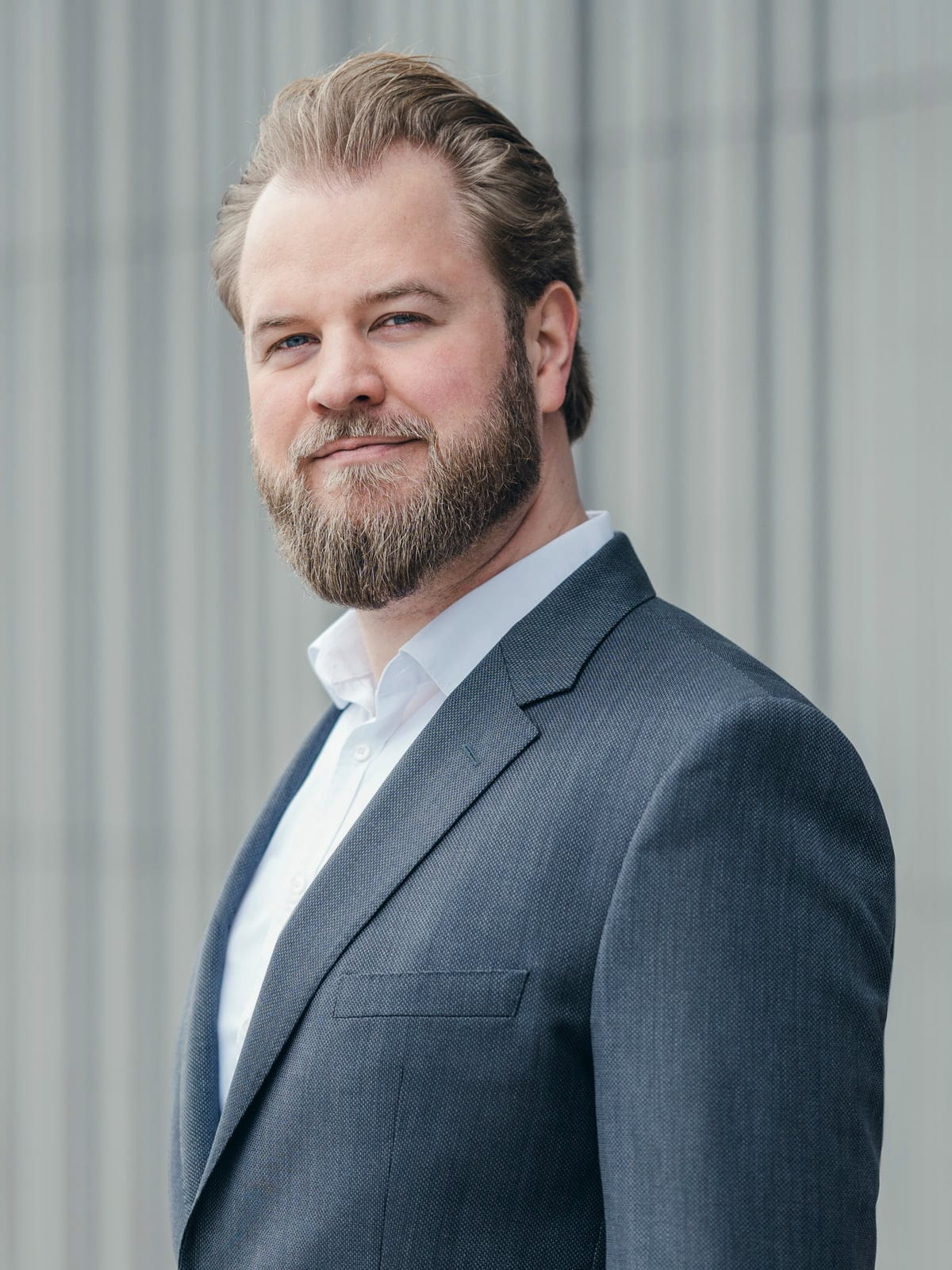
Managing Director & CTO
Across a range of industrial companies — from intralogistics through machine and plant engineering to production data processing — I kept encountering the same thing: capable engineers, good machines, well-thought-out processes. And in between, systems that don't talk to one another. Protocol breaks, isolated solutions, manual workarounds. Not because no better solution existed — but because the friction between systems was rarely seen as the real problem. For me, it was. And at Traeger, I found a company that tackles exactly that.
From 2013, I worked with Alois Träger to evolve the product architecture — with the goal of making our solutions fit seamlessly into the ecosystem that software developers in industry know and expect. Individual libraries became a well-considered SDK family; point solutions became a platform. The LINK SDKs, the OPC UA SDK, the Codabix middleware — they bear the signature of a team I helped build and shape. What drives me goes beyond any single product: when data flows freely, processes mesh together. Friction dissolves. And people can focus on what they actually want to do — build machines, run plants, develop and manufacture products. Those moments, when a system starts to work quietly and intuitively, are the reason I'm at Traeger.
Since 2020 I've led the technical direction as CTO, and since 2022 the management of the company. I advise our customers personally, run workshops, and support projects strategically from planning to integration. Together with my team, we lead and accompany our customers on the path of their industrial transformation — vendor-independent, first-hand, and as equals.
Every machine you integrate today has to talk tomorrow to systems that don't exist yet. We build the tools that make that possible — without forcing you to throw out your existing infrastructure.
We enable vendor-independent data exchange between machines, systems, and people. No isolated solutions, no workarounds — just connections that hold.
Industrial systems grow over years. We want to help keep them manageable and dependable even as complexity increases — so today's investments still pay off tomorrow.
We develop SDKs, middleware, and integration tools that connect machines and systems — regardless of manufacturer, protocol, or bus system. Straight from the developer, no detours.
Three independent awards — for service quality, employer quality, and sustained performance. Not claimed by us, but confirmed through surveys and ratings.
Awarded in the categories of quality, performance, service, and effectiveness — based on customer surveys, mystery checks, and over 40 assessment criteria.
Awarded on the basis of an anonymous employee survey. Appreciation, workplace culture, and development opportunities — rated by the people who work here.
Awarded the highest score in the MDL points system two years running — measured against companies in the same industry across the DACH region. Recognition for sustained performance and consistent quality.
The Upper Palatinate is one of Bavaria's most industrialized regions — shaped by mid-sized global market leaders, semiconductor manufacturers, and machine builders. Companies like Infineon, ams-OSRAM, Krones, Maschinenfabrik Reinhausen, and Siemens develop and manufacture here. Many of them are our customers and neighbors. We know their systems because we've been building the software that connects them for over 30 years.
This is where it all comes together: product development, architecture, sales, and support. Right on the A93 between Regensburg and Hof — in the heart of the northern Upper Palatinate.
The OTH Amberg-Weiden — one of the few universities in Germany with its own degree program in Industry 4.0 informatics and artificial intelligence — is just minutes away.
In the NUWORK complex in Dörnberg — at the center of one of southern Germany's most dynamic technology hubs. Infineon, ams-OSRAM, and Siemens manufacture and research right nearby.
With the University of Regensburg and the OTH Regensburg, the city offers one of the strongest research and talent pools in Eastern Bavaria. We're a member of Stadtmarketing Regensburg and thus actively connected to the local business community.
Our products run in factories on six continents. They're developed and supported right here — in Bavaria.
Have a project, a question, or an idea? We listen — and tell you openly how we can help.